Airplane crashes into ocean in Micronesia

">
Airplane crashes into ocean in Micronesia

Saturday, September 29, 2018

Yesterday morning near the international airport located on Weno island of Chuuk state of the Federated States of Micronesia, Oceania a passenger airplane of model Boeing 737-800 flown by the Air Niugini carrier crashed into sea as its pilot missed the runway. All 47 people on board — by differing reports, 36 passengers and eleven crew or 35 passengers and twelve crew — survived.

The report by the international commercial aviation safety organization Jet Airliner Crash Data Evaluation Centre indicated the crash coincided with a sudden intensification of the weather conditions. timeanddate.com-supplied data from CustomWeather reported rain showers at 9:40 a.m. local time, following cloudy conditions at 8:50 a.m.

The airplane reportedly landed around 9:30 a.m. local time, short of the runway by about 160 m to 200 m (about 525 to 650 feet), according to reports. Locals immediately began to rescue the passengers and crew on fishing boats. Officials arrived after about ten minutes, according to a witness quoted by The Guardian.

In an interview, a passenger alleged the crew started panicking and yelling, The Guardian reported. A first responder, Dr James Yaingeluo, also said the airplane crew were in panic. He said, “There was a little bit [of] chaos at first because everybody was really panicked and tried to get out of the plane […] other than that we were doing as much as we can. Luckily there are no casualties.”

Yaingeluo said nine people were taken to a hospital. Four people remained in hospital, one “seriously injured”, according to reports recounted by ABC News on Friday evening.

Flight 73 was coming from Pohnpei in the Federated States of Micronesia. Its destination was Port Moresby in Papua New Guinea, with a stop at the Chuuk state.

">Digg
  • Airplane crashes into ocean in Micronesia
  • ">Del.icio.us
  • Airplane crashes into ocean in Micronesia
  • ">StumbleUpon
  • Airplane crashes into ocean in Micronesia
  • ">Reddit
  • Twitter
  • RSS
  • The Deadliest Fall

    ">
    The Deadliest Fall

    18 December 2004

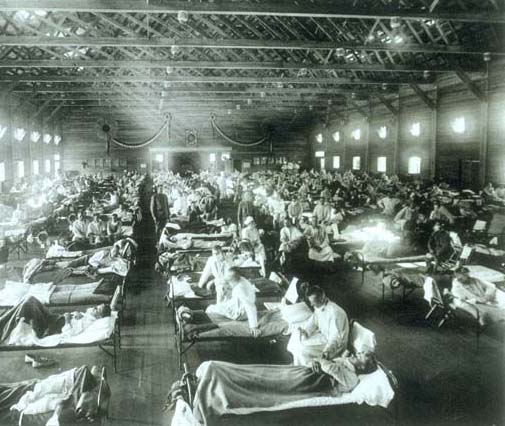
    Emergency hospital during 1918 influenza epidemic, Camp Funston, Kansas (source: National Museum of Health and Medicine, AFIP).

    A bout of the flu can be mild. In young, healthy adults, many infections pass unnoticed. But sometimes the influenza virus evolves into a strain that decimates its victims. The worst known strain swept the world in the Fall of 1918, infecting 500-1000 million and killing 40-100 million, about 2-5% of people.

    There are several theories about where the pandemic began, but the likeliest origin was in Haskell County, Kansas, in the United States. People in the sparsely populated county, where farmers raised pigs, poultry, cattle, and grain, began suffering from influenza in late January 1918. Unusually for flu, it was young, healthy adults who were hardest hit. Victims fell ill suddenly, many progressing to pneumonia and dying, often within days. Within weeks, however, the epidemic ended. The natural geographic isolation of this community normally might have contained the fatal flu in a sort of unintentional quarantine, but the First World War intervened. Men were uprooted from their home towns and congregated in huge numbers in army camps for training and then shipping out to other camps or to fight in Europe. The destination for men from Haskell County was Camp Funston, part of Fort Riley, Kansas, where the first influenza case was reported in early March. As soldiers moved among camps, the virus spread. Within two months, the epidemic spread to most of the army camps and most of the largest cities in the United States. As American soldiers went to France, so did the virus, spreading first from the port of Brest.

    The flu then spread worldwide. The pandemic reached its height in the Fall of 1918. Spain was affected early, and because Spain was not fighting in the World War, there was no wartime censorship, and news of the outbreak became widely known, leading to the flu being called the Spanish Flu in many countries. In Spain, however, it was called French Flu or the Naples Soldier. In India, about 12 million people died of flu. In some US cities, people died so quickly that morticians couldn’t cope with the bodies. According to Jessie Lee Brown Foveaux, who worked in the Fort Riley laundry during the epidemic: “They were piling them up in a warehouse until they could get coffins for them.”

    The disease started with cough, then headache. Temperature, breathing and heart rate increased rapidly. In the worst cases, pneumonia came next, the lungs filling with liquid, drowning the patients and turning them blue from lack of air. Patients bled from every orifice: mouths, noses, ears, eyes. Those who survived often suffered temporary or permanent brain damage. Several million developed encephalitis lethargica, in which victims were trapped in a permanent sleeplike and rigid state, as portrayed in the 1990 movie “Awakenings.” In others, normal thought processes were impaired. During negotiations to end World War I, US President Woodrow Wilson was struck with flu, and people around him noted that his mental abilities never fully recovered. The French leader George Clemenceau had wanted harsher punishment of Germany than Wilson had desired. Clemenceau may have convinced Wilson in his weakened state to accept such harsh terms, which may have been one of the factors causing World War II.

    Since flu is highly contagious early in the illness, even before symptoms appear, strict quarantine may be necessary to stop its spread during an epidemic. Australia kept its 1918 flu death rate relatively low by enforcing quarantines. However, in many parts of the world, public health officials hesitated to impose such measures, giving the disease time to gain a foothold. In the US city of Philadelphia, a rally of half a million people was planned in September 1918 to sell bonds to fund the war, at just the time when the flu started to infect residents. Although doctors warned the public health director to cancel the rally, he wanted to meet the city’s quota to raise money for the war and refused to cancel the event. Within days after the rally, half a million city residents caught the flu.

    Why was the 1918 flu so deadly? The influenza virus wasn’t preserved at the time of the outbreak, at least on purpose. But in the late 1990s researchers Ann Reid, Jeffery K. Taubenberger, and their colleagues extracted and sequenced the genetic material of the virus, RNA, from tissue of victims who died in the pandemic. They used bits of lung that were preserved in formalin from victims on army bases or from victims buried in permafrost in the Alaskan village of Brevig Mission, where flu killed 85% of adults. Comparisons with known flu viruses in humans, pigs, and birds suggest that some genes of the 1918 virus came from birds or an unknown animal source. Other scientists then were able to show that the amino acid sequence of hemagglutinin protein from the 1918 virus had several changes from other flu viruses that may have helped it to easily bind and invade human cells, and that made the virus look different enough from earlier flu virus strains that people had no immunity.

    The possibility exists that another flu pandemic will sweep the world like the one in 1918. In 2004, an H5N1 influenza virus has killed millions of birds and at least 30 people in southeast Asia. So far this virus strain has not evolved the ability to pass directly from human to human, but that possibility becomes more likely as the bird flu pandemic continues and humans remain in contact with chickens, ducks, and other birds. The virus has killed two-thirds of people reported to be infected. Dr. Tim Uyeki, an epidemiologist for the US Centers for Disease Control, says, “you have the ingredients in Asia right now for a public health disaster.”

    But since sequences of this bird flu virus are known, it may be possible to develop a vaccine or set of vaccines to protect against it. At a special meeting of influenza experts on November 11th and 12th, World Health Organization influenza program chief Klaus Stohr said, “It is not only possible, but also important, that influenza pandemic vaccines be made available… and there’s a shared responsibility needed to make that happen…. We have a huge window of opportunity now.”

    ">Digg
  • The Deadliest Fall
  • ">Del.icio.us
  • The Deadliest Fall
  • ">StumbleUpon
  • The Deadliest Fall">Reddit
  • Twitter
  • RSS
  • Read User's Comments(0)

    US Republicans query Linux Foundation about open-source security

    ">
    US Republicans query Linux Foundation about open-source security
    Posted in Uncategorized | January 26th, 2019

    Wednesday, April 4, 2018

    On Monday, two US Republican Party legislators, Greg Walden and Frank Pallone Jr., respectively the chairman and the ranking member of the United States House Committee on Energy and Commerce, co-wrote a public letter to Jim Zemlin, executive director of The Linux Foundation, about open-source software (OSS) and improving its security. They requested Zemlin to answer their questions by no later than April 16.

    The letter contained the following four questions; each of the first two has a further two follow-up questions.

    1. Has the CII [Core Infrastructure Initiative] performed a comprehensive study of which pieces of OSS are most crucial to the “global information infrastructure”?
      1. If not, does the CII plan to perform such a study?
      2. What would the CII need in order to do so?
    2. Has the CII, or any other organizations, compiled any statistics on OSS usage?
      1. If not, does the CII plan to perform such a study?
      2. What would the CII need in order to do so?
    3. In your estimation, how sustainable and stable is the OSS ecosystem?
    4. Based on your response to the previous question, how can the OSS ecosystem be made more sustainable and stable?

    Walden and Pallone exemplified Heartbleed, a “critical cybersecurity vulnerability” that allowed the hacking of websites and passwords, and millions of medical records in 2014. They also wrote that, in response to that vulnerability, The Linux Foundation established a multi-million dollar project, the Core Infrastructure Initiative, intended to improve the global infrastucture of such software.

    The politicians noted large tech companies like Microsoft, Apple Inc., and Adobe Systems respond more quickly to such critical vulnerabilities than distributors and developers of open-source software.

    Open-source software is “publicly accessible” and usually freely-licensed for a wide range of use, such as modification and commercial uses. Walden and Pallone also expressed praise toward open-source software and cited a 2015 survey conducted by Black Duck Software saying 78% of companies used such software.

    ">Digg
  • US Republicans query Linux Foundation about open-source security">Del.icio.us
  • US Republicans query Linux Foundation about open-source security">StumbleUpon
  • US Republicans query Linux Foundation about open-source security">Reddit
  • Twitter
  • RSS
  • Read User's Comments(0)

    Benefits Of Letting Experts Do Roof Installation In Hitchcock, Tx For You

    Posted in Earthmoving Equipment | January 26th, 2019

    Click Here For More Specific Information On:

    byAlma Abell

    A roof is one of the most important parts of the building. This is because it protects the house and the occupants from excessive sunshine, heat, wind and rainfall. The roof adds aesthetic values to the home. However, to have a beautiful and safe home, you need to get experts to do roof installation in Hitchcock, TX for you.

    [youtube]http://www.youtube.com/watch?v=EEj0KBzYWzY[/youtube]

    The first benefit of working with experts is that they guide you in choosing the best roofing material for your house. The most common materials that you will have to choose from including shingles, tiles, metal roofs, and cedar shakes. Each of the materials has its advantages and disadvantages. For instance, shingle roofs are great when you want a cool house. Such rooftops are long lasting. However, they do not do so well if you want to do rain water harvesting. These are the factors that the roof installation in Hitchcock, TX experts will want you to look at before you choose your material.

    The other benefit that comes from using these experts is that they will help you to do cost estimation. The task of roofing takes up a great budget. It needs planning and preparation. Good contractors will take measurements of the area that has to be roofed in square meters. They will then take into consideration the roofing style you want and estimate the cost for you.

    Another benefit of hiring a good company is that they will have insurance costs covered. Most roofing jobs are quite dangerous. This means that if you contract a roof installation in Hitchcock, TX Company that doesn’t have the coverage, you might end up with liability charges in the case of an accident. Besides that, you need to deal with a contractor that will take the responsibility for any mistakes that they commit during the installation of the roof.

    Experts in roof installation in Hitchcock, TX will offer you those benefits and others when you allow them to work on your roofing. The Guaranteed Roofing Company gives the best roofing services in the city. They are committed to offering quality materials at affordable rates and ensuring that their clients are satisfied all times.

    Read User's Comments(0)

    Curfew in Haryana as protesters demand reservation for Jat quota

    ">
    Curfew in Haryana as protesters demand reservation for Jat quota
    Posted in Uncategorized | January 26th, 2019

    Sunday, February 21, 2016

    A growing number of cities in the Indian state Haryana have been under curfew since Friday. At least eight people are reported dead, with government offices, property, dozens of buses, and eight railway stations burned after protests over job quotas for the Jat caste turned violent in several cities including Rohtak, Bhiwani, and Jhajjar. Reportedly some protesters broke into an armory in Rohtak, stealing arms and ammunition.

    I appeal to all my fellow Haryanvis to maintain law & order in the State, and ensure that harmony is maintained in society.

    Shoot-at-sight was ordered for Rohtak, Bhiwani, Sonipat, Panipat, Jhajjar, Jind and Hisar. Shops, hotels, and restaurants were set afire by protesters. Thirteen national army columns were called, and helicopters were used to reach various places in the state. Internet was disabled in affected districts, and the state government ordered blocks of all social networking websites.

    Chief Minister Manohar Lal Khattar held a meeting to decide if Jats should also gain the reservation rights for government jobs and colleges by classifying them under Other Backwards Castes.

    Burning of stations and uprooting of tracks affected 810 scheduled trains, according to The Indian Express. Police said protesters torched Finance Minister Captain Abhimanyu’s house. The state might face water crises. Central Board of Secondary Education (CBSE) was to hold the Haryana Central Teacher Eligibility Test today, but cited “administrative difficulties” for suspending it.

    Back in 2014, the UPA government appealed for a Jat quota which was rejected by the Supreme Court. This morning, Manohar Khattar tweeted “I appeal to all my fellow Haryanvis to maintain law & order in the State, and ensure that harmony is maintained in society.”

    Last year, similar protest took place in Gujarat as Patels protested for reservation led by Hardik Patel.

    ">Digg
  • Curfew in Haryana as protesters demand reservation for Jat quota">Del.icio.us
  • Curfew in Haryana as protesters demand reservation for Jat quota">StumbleUpon
  • Curfew in Haryana as protesters demand reservation for Jat quota">Reddit
  • Twitter
  • RSS
  • Read User's Comments(0)

    Sewerage project starts in Pakistan

    ">
    Sewerage project starts in Pakistan
    Posted in Uncategorized | January 26th, 2019

    Friday, January 19, 2007

    In Pakistan, the Daily Times reported that construction work on a sewerage project has started in Pindi.

    It said that the construction work for the Rawalpindi Environment Improvement Project (REIP) aims to lay a new underground drainage and sewerage system in the area.

    The project director of REIP, Aslam Sabzwari, said, according to the report, that improvement of sanitation and sewerage system had started in the eastern zone of the city, consisting of 15 union councils (UCs). The project includes improvement of the sanitation and sewerage systems, a sewage treatment plant, solid waste management, removal of slaughter-houses and construction of public toilets.

    Sabzwari also said that 22 new tube wells would be installed, while 32 old ones would be repaired under the project, recalling that the existing sewerage systems in Satellite Town and Kahyabane-Sirsyed were laid in the 1950s and 1969s, respectively, and were the main cause of the increasing case of hepatitis in the city.

    Asian Development Bank (ADB) and the Punjab government sponsor the REIP.

    ">Digg
  • Sewerage project starts in Pakistan">Del.icio.us
  • Sewerage project starts in Pakistan">StumbleUpon
  • Sewerage project starts in Pakistan">Reddit
  • Twitter
  • RSS
  • Read User's Comments(0)

    Darling announces UK budget for 2009

    ">
    Darling announces UK budget for 2009
    Posted in Uncategorized | January 26th, 2019

    Thursday, April 23, 2009

    The United Kingdom Chancellor of the Exchequer, Alistair Darling, yesterday announced the 2009 budget. The budget is an annual audit of the nation’s finances, and decides what should be done with taxpayers’ money.

    The chancellor fell under scorn for his GDP growth forecasts, which are considered to be too optimistic in predicting that Britain will bounce back from its weakest economic performance since the end of the second world war. Darling forecast GDP growth of 3.5% in 2011, even after he was made to downgrade his predictions. He expects a record expansion of 1.25% next year, but chief UK economist Howard Archer disagrees, calling Darling’s predictions “mildly optimistic in the near term and much more optimistic in the long term.”

    HAVE YOUR SAY
    Was the increase in the ISA limit “too little, too late”?
    Add or view comments

    His plans for savers and pensioners, however, were commended by many, though was also criticised by a large portion of the populace. In the budget, Darling increased the amount that savers can put into an Individual Savings Account (ISA) from £7,200 to £10,200, of which £5,100 can be saved in cash. These increased limits will be available only to people aged over 50 from 6 October this year, and will not be available to everyone until 6 April next year. A number of financial experts described the move as being “too little, too late”, and Rumina Hassam, of price comparison website uSwitch.com, said: “The government’s decision to increase the cash ISA limit by £1,500 to £5,100 for the over 50’s is a just another kick in the teeth for the majority of savers as they will have to wait even longer to benefit. There is no doubt that savers have been sacrificed as a result of the plummeting base rate, bringing savings rates to an all time low.”

    ">Digg
  • Darling announces UK budget for 2009">Del.icio.us
  • Darling announces UK budget for 2009">StumbleUpon
  • Darling announces UK budget for 2009">Reddit
  • Twitter
  • RSS
  • Read User's Comments(0)

    Eurovision ’73 winner Anne Marie David discusses her four-decade career and the Contest, past and present

    ">
    Eurovision ’73 winner Anne Marie David discusses her four-decade career and the Contest, past and present
    Posted in Uncategorized | January 26th, 2019

    Monday, February 16, 2009

    In the 1970s, she was one of the most popular female vocalists in France, and became well-known internationally. Anne Marie David, from Arles in the south of France, parlayed her initial success from playing Mary Magdalene in the French production of Jesus Christ Superstar into taking home the “grand prix” at the Eurovision Song Contest in 1973. Her winning song, “Tu te reconnaîtras” (You will recognize yourself), became a Europe-wide hit that spring.

    At the height of her popularity, David perfomed world tours, and even lived abroad in Turkey for a time. In 1979, she tried once again to win the Eurovision, and placed a respectable third. Her song “Je suis l’enfant soleil” (I’m a child of the sun) became similarly popular across France and in the Francophone nations.

    As time went on, however, her place in the French music scene became less certain. Touring the world had taken a personal toll, and David decided to retire from music completely in 1987. However, with the help of her fan base, she was coaxed out of retirement in 2003 and is returning to a part of her life that she tried to leave, but never left her. Celebrating four decades in the music scene, David is looking forward to adventurous new projects and a newfound zest for life.

    Anne Marie David corresponded with Wikinews’ Mike Halterman about her eventful career, her personal anecdotes regarding living abroad, her successes in past Eurovision contests and her grievances with the way the show is produced today. This is the second in a series of interviews with past Eurovision contestants, which will be published sporadically in the lead-up to mid-May’s next contest in Moscow.

    ">Digg
  • Eurovision ’73 winner Anne Marie David discusses her four-decade career and the Contest, past and present">Del.icio.us
  • Eurovision ’73 winner Anne Marie David discusses her four-decade career and the Contest, past and present">StumbleUpon
  • Eurovision ’73 winner Anne Marie David discusses her four-decade career and the Contest, past and present">Reddit
  • Twitter
  • RSS
  • Read User's Comments(0)

    Computer professionals celebrate 10th birthday of A.L.I.C.E.

    ">
    Computer professionals celebrate 10th birthday of A.L.I.C.E.
    Posted in Uncategorized | December 22nd, 2018

    Wednesday, November 30, 2005File:Turing1.jpg

    More than 50 programmers, scientists, students, hobbyists and fans of the A.L.I.C.E. chat robot gathered in Guildford, U.K. on Friday to celebrate the tenth birthday of the award winning A.I. On hand was the founder the Loebner Prize, an annual Turing Test, designed to pick out the world’s most human computer according to an experiment laid out by the famous British mathematician Alan Turing more then 50 years ago. Along with A.L.I.C.E.’s chief programmer Dr. Richard S. Wallace, two other Loebner prize winners, Robby Garner and this year’s winner, Rollo Carpenter, also gave presentations, as did other finalists.

    The University of Surrey venue was chosen, according to Dr. Wallace, not only because it was outside the U.S. (A.L.I.C.E.’s birthday fell on the Thanksgiving Day weekend holiday there, so he expected few people would attend a conference in America), but also because of its recently erected statue of Alan Turing, who posed the famous A. I. experiment which inspired much of the work on bots like A.L.I.C.E. University of Surrey Digital World Research Centre organizers Lynn and David Hamill were pleased to host the event because it encourages multi-disciplinary interaction, and because of the Centre’s interest in interaction between humans and computers.File:ALICE Birthday Cake.jpg

    Dr. Wallace gave a keynote address outlining the history of A.L.I.C.E. and AIML. Many people commented on the fact the he seemed to have moved around a lot in the last ten years, having lived in New York, Pennsylvania, San Francisco, Maine, Amsterdam and Philadelphia, while working on the Alicebot project. The A.L.I.C.E. and AIML software is popular among chat robot enthusiats primarily because of its distribution under the GNU free software license. One of Dr. Wallace’s PowerPoint slides asked the question, “How do you make money from free software?” His answer: memberships, subscriptions, books, directories, syndicated ads, consulting, teaching, and something called the Superbot.

    Rollo Carpenter gave a fascinating presentation on his learning bot Jabberwacky, reading from several sample conversations wherein the bot seemed amazingly humanlike. Unlike the free A.L.I.C.E. software, Carpenter uses a proprietary learning approach so that the bot actually mimics the personality of each individual chatter. The more people who chat with Jabberwacky, the better it becomes at this kind of mimicry.

    In another interesting presentation, Dr. Hamill related present-day research on chat robots to earlier work on dialog analysis in telephone conversations. Phone calls have many similarities to the one-on-one chats that bots encounter on the web and in IM. Dr. Hamill also related our social expectations of bots to social class structure and how servants were expected to behave in Victorian England. He cited the famous Microsoft paperclip as the most egregius example of a bot that violated all the rules of a good servant’s behavior.

    Bots have advanced a long way since philanthropist Hugh Loebner launched his controversial contest 15 years ago. His Turing Test contest, which offers an award of $100,000 for the first program to pass an “audio-visual” version of the game, also awards a bronze medal and $2000 every year for the “most human computer” according to a panel of judges. Huma Shah of the University of Westminster presented examples of bots used by large corporations to help sell furniture, provide the latest information about automotive products, and help customers open bank accounts. Several companies in the U.S. and Europe offer customized bot personalities for corporate web sites.

    Even though Turing’s Test remains controversial, this group of enthusiastic developers seems determined to carry on the tradition and try to develop more and more human like chat bots.Hugh Loebner is dedicated to carry on his contest for the rest of his life, in spite of his critics. He hopes that a large enough constituency of winners will exist to keep the competition going well beyond his own lifetime. Dr. Wallace says, “Nobody has gotten rich from chat robots yet, but that doesn’t stop people from trying. There is such a thing as ‘bot fever’. For some people who meet a bot for the first time, it can pass the Turing Test for them, and they get very excited.”

    ">Digg
  • Computer professionals celebrate 10th birthday of A.L.I.C.E.">Del.icio.us
  • Computer professionals celebrate 10th birthday of A.L.I.C.E.">StumbleUpon
  • Computer professionals celebrate 10th birthday of A.L.I.C.E.">Reddit
  • Twitter
  • RSS
  • Read User's Comments(0)

    US researchers increase tobacco’s oil production for biofuel use

    ">
    US researchers increase tobacco’s oil production for biofuel use
    Posted in Uncategorized | December 22nd, 2018

    Sunday, January 3, 2010

    A team of researchers from the Thomas Jefferson University‘s Biotechnology Foundation Laboratories (BFL) in the United States have managed to increase the amount of oil produced by tobacco leaves. Tobacco oil can be very efficiently converted to biofuel, but most oil is located in the seeds, which the plant does not produce many of.

    Tobacco seeds produce around 40% oil per dry weight but a crop of the plant yields only around 600kg of seeds per acre. The leaves have an oil content of around 1.7–4% oil per dry weight. The oil has previously been tested for powering diesel-fueled vehicles and can be more efficiently converted than the product of many other crop plants.

    The team from BFL identified that oil production in the leaves was controlled by two genes: the diacyglycerol acytransferase (DGAT) and the LEAFY COTYLEDON 2 (LEC2) genes. By genetic engineering, they achieved oil yields of 5.8% oil per dry weight by modifying the DGAT while changes to the LEC2 resulted in a yield of 6.8% per dry weight.

    “Tobacco is very attractive as a biofuel because the idea is to use plants that aren’t used in food production,” said cancer biology assistant professor at Thomas Jefferson Dr Vyacheslav Andrianov, Ph.D. “In some instances, the modified plants produced 20-fold more oil in the leaves.”

    Various efforts are being made to find biofuel sources that are not also potential food, in order to steer clear of causing further rises in global food costs. Last month the US government anounced funding for research that used nonphotosynthesising micro-organisms to manufacture biodiesel, in the hope that this will prove more efficient than options that rely on photosynthesis. This also escapes one criticism of biofuels like tobacco; that competition for land to grow crops on will result in biofuel crops displacing foodstuffs and pushing food prices up. In November 2009 a Spanish team launched a study to determine if tobacco, as well as the prickly pear, was capable of withstanding the harsh conditions of land not suitable for growing food, selecting these plants for their ability to survive water shortages.

    ">Digg
  • US researchers increase tobacco’s oil production for biofuel use">Del.icio.us
  • US researchers increase tobacco’s oil production for biofuel use">StumbleUpon
  • US researchers increase tobacco’s oil production for biofuel use">Reddit
  • Twitter
  • RSS
  • Read User's Comments(0)
    « Older Entries
    Newer Entries »